
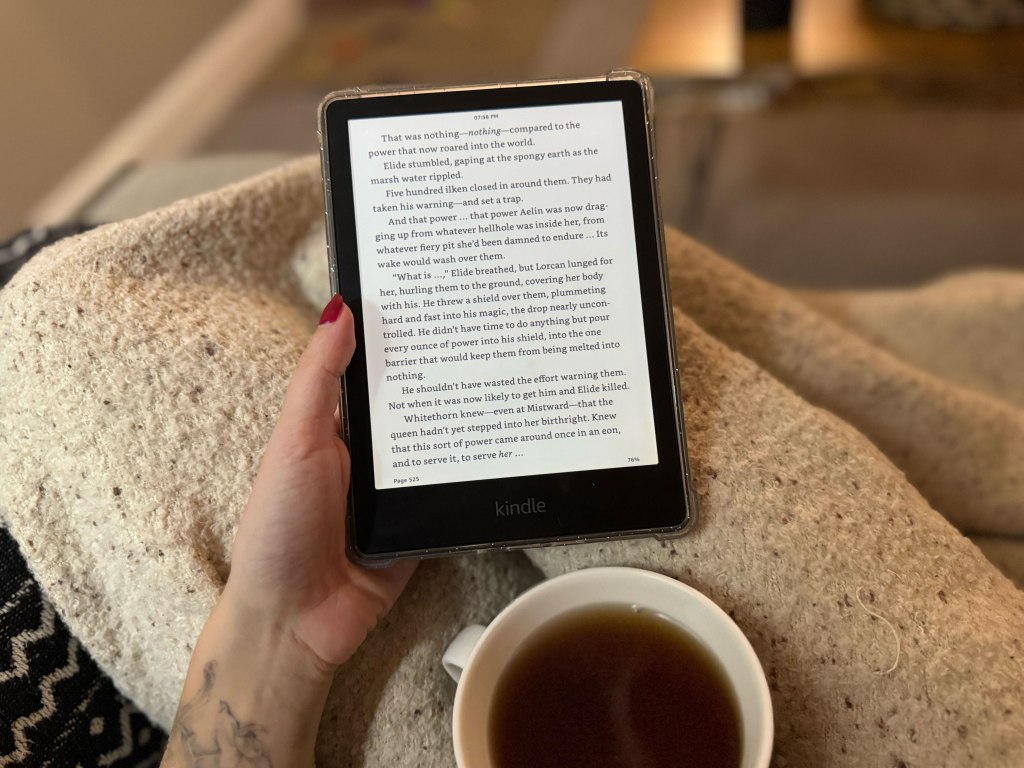
I have always loved reading. As a kid, I had drawers filled with books in my bedroom. Books were an escape for me. Being capable of transporting myself into another world, another story was so magical for me. I enjoyed the books I read in English class during high school, but during college I fell off the reading train. I sort of just stopped because I was so busy between being a full-time student and working. It wasn’t until two Christmases ago when I fell back in love. I asked my parents to get me a Kindle Paperwhite because I thought maybe an e-reader would make me read more. I was correct. I love my Kindle. I take it anywhere that I go just in case I have a chance to read a couple of pages. I’ve even decorated it with cute book themed stickers and a clear, sparkly case. My Kindle made reading fun for me again. Then, I discovered BookTok, the subgenre of TikTok that is basically a giant book club. On Instagram, it’s known as Bookstagram. BookTokers recommend their favorites, talk about their DNF (did not finish) books, and share the love of reading all around. I loved BookTok. Some of my favorite reads were BookTok recommendations. After I deleted TikTok, in my quest to reduce screen time, I started to think about how BookTok is really effecting readers and I didn’t love it quite so much anymore.
The Downfall of Reading
I see myself as kind of an anomaly. I live in a world of technology, but I love the written word (granted I do most of my reading on a tech-powered device). When I’m asked what my hobbies are, I say reading and people kind of look at me funny. Reading? Do people even read anymore? The short answer is no. At least, not in the way that they used to. In his book Stolen Focus, author Johann Hari states that since 2017 the average American spends just seventeen minutes a day reading book while spending 5.4 hours a day on their phone. Reading is a commitment that not everybody has the time for. It requires deep focus and attention that will take a lot of time. The problem is that people don’t have that focus anymore. We can’t read like we used to. Author Michael Harris feels the affect himself despite having a career in books. He once said at a dinner with a friend, “I think I’ve forgotten how to read”. Harris states that as a society we have become “cynical readers”. Readers who now loathe sitting for extended periods of time to with the intent to gain knowledge and instead read simply to find the next best thing to post, Tweet, or share. It’s because we’re surrounded by so much short form content that our brains can no longer handle a lack of stimulation. When we’re bored we sit and scroll. We fill our brains with as much mindless nonsense as possible to fill the gaps of time in our schedules. Social media has taken over our lives beyond doubt and it is killing our attention spans, We don’t pick up a book simply out of the desire to pick up a book anymore. Instead we pick up our phones and scroll away.
The Rise of BookTok
In our world of social media, it would seem that BookTok is a breath of fresh air. BookTok promotes reading and isn’t that what we want? We want people to choose to pick up a book instead of their phones. So what makes BookTok so special? BookTok rose in popularity in 2020 during the COVID-19 pandemic when there wasn’t much to do while being stuck inside. Many people turned to books to pass the time and then decided to share it online. One of the greatest things about reading is that it can induce a “flow state” – a mental state of feeling completely immersed in what you are doing. Mihály Csíkszentmihályi, who first discovered the flow state, says that a flow is the secret to happiness. A flow can be found at the perfect balance of our current level of ability and the level of difficulty of the task. Flow states have many mental benefits including; reduced depression and a higher level of concentration. In a way, BookTok is promoting achieving a flow state. BookTokers share the books they have read and recommend which in turn makes viewers want to read more. BookTok is bringing people together to bond through their shared love of reading. The rate of reading has gone up in recent years since the rise in BookTok’s popularity. All of this sounds great until you are deep into BookTok and really get to understand the novels that are being recommended.
How BookTok is Actually Ruining Reading
BookTok is overall a truly positive place. During my time as a follower, I didn’t see much negativity in the space and there was an overall respect towards people’s opinions. But BookTok is ruining reading. While this is a bold claim, I mean it with the utmost respect to BookTokers as they’re not intentionally causing harm. The books that BookTokers are recommending aren’t literary works of art. They aren’t recommending authors like F. Scott Fitzgerald, Emily Dickinson, or Agatha Christie. They are recommending books with one or two tropes and simple plots. Simply put – these books aren’t making us smarter. In an opinion piece written by Johns Hopkins University student, Isabella Madruga, she believes that because of this increase of low-level reading material people won’t venture off into books that need more analysis. Madruga shares that because of the rise in these types of novels that publishers and booksellers are feeling pressured to keep churning them out. I agree with Madruga. The books I have seen recommended and even read from BookTok are, for lack of a better word, simple. They follow a very similar formula with very predictable plots. These plots lack the nuances and deeper meanings that authors of the past always ensured were behind their words. Don’t get me wrong it brings me joy that there is now such a large community around reading now. Reading is becoming cool again. Certain people like different things and it’s okay to have an opinion. But, it’s important to be aware of what we are choosing to read. Picking up an ice hockey romance isn’t going to do much except keep you entertained for a bit. To fix the reading crisis we are facing, there has to be an awareness of the material being written. The next time you pick up a book, take a moment to pause and think about what you are looking to gain by reading that book.





 Pixel + Parchment
Leave a comment