
Ellen Lupton reminds us in her book, Design is Storytelling, that “design is the art of thinking ahead and predicting possible futures”. Her ideas about scenario planning and design fiction show how design can move beyond solving problems and can visualize what might come next. These tools connect directly to visual storytelling which then helps designers create worlds that aren’t real yet, but can be imagined.
Scenario Planning: Drawing the Map of Possibility
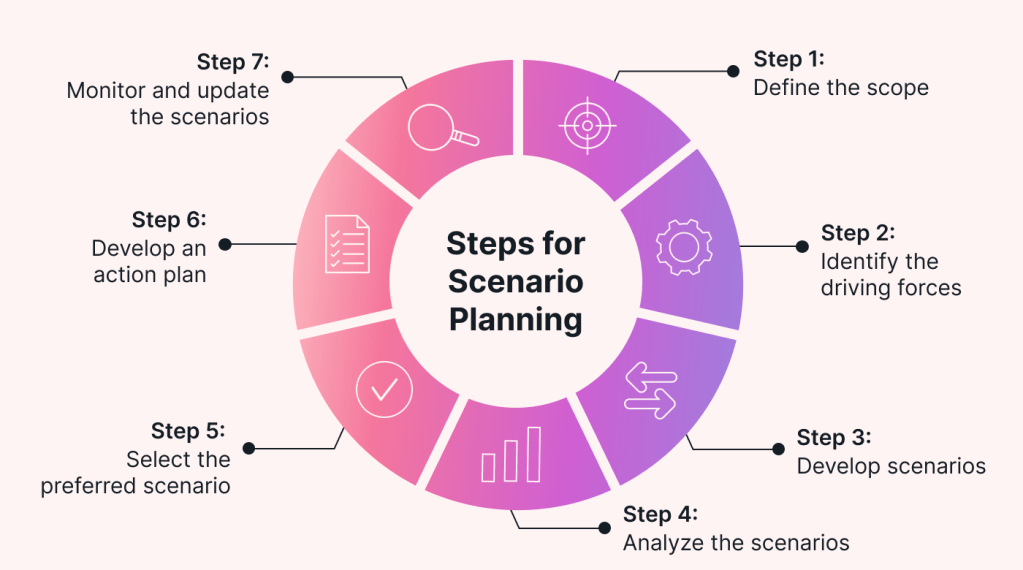
Scenario planning began as a method for business and strategic forecasting, but has quickly become a creative process for designers. Instead of predicting a singular future, it brings many to life. The Great Lakes Integrated Sciences and Assessments (GLISA) group defines it as a process for managing uncertainty by developing a set of plausible scenarios. For visual designers, that means imagining how interfaces, spaces, or experiences might look in different worlds depending on growth, collapse, discipline, or transformation. A designer can storyboard these worlds to look at near and far off futures. This turns visual design into a means of storytelling that stretches across both time and space.
Design Fiction: Creating Artifacts from Imaginary Worlds
If scenario planning maps the future, then design fiction builds the props. It creates speculative artifacts like, objects, posters, or media that feel like they belong to a future society. According to Near Future Laboratories, design fiction is “one way we can render tangible, future scenarios before taking action”. The objects created from design fiction allow designers to ask questions rather than give answers they might not have. “Would this world be desirable?” “Who benefits and who’s excluded?” In visual design, this might be a futuristic product ad, a cereal box design for a bug based cereal, or a user interface for a social media that doesn’t exist yet.
My Experience: “The Thing from the Future”
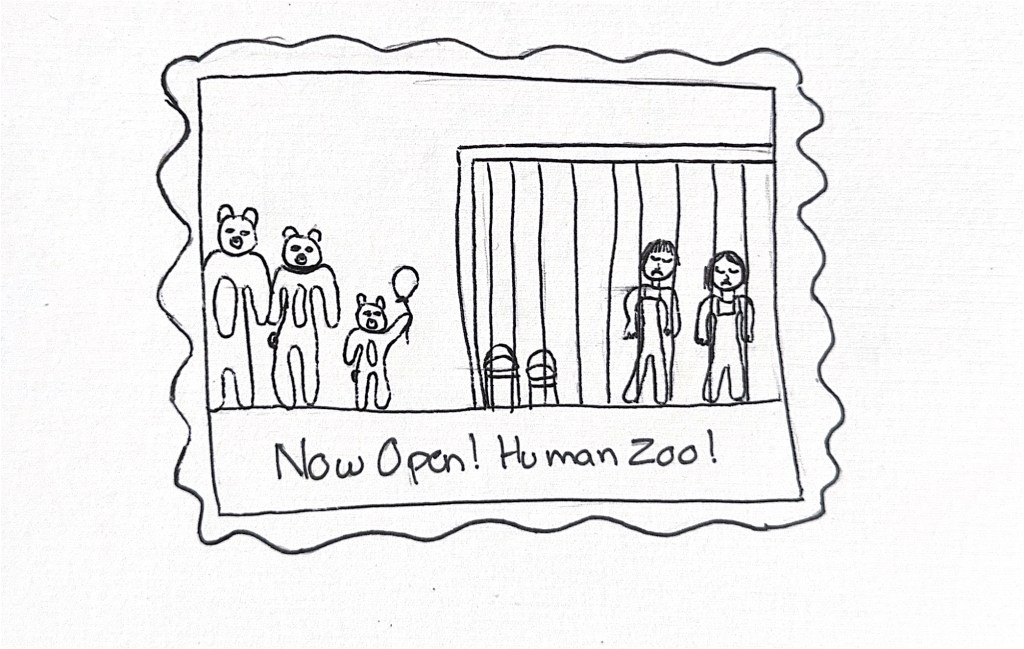
In my game of The Thing from the Future, I drew the cards: a transformation future, related to the zoo, and a postcard. I imagined a world where the animals evolved to the point of taking over the humans. In this future, the humans were placed in zoos, like how we do to animals now, and were looked upon for pure entertainment. The humans in the cage are sad because of the conditions they live in. A family of bears watches them while the child bear holds a balloon to symbolize that they are there for fun. The postcard itself says, “Now Open! Human Zoo!” to advertise that the new attraction is open and to draw in more visitors.
Why It Matters for Visual Design
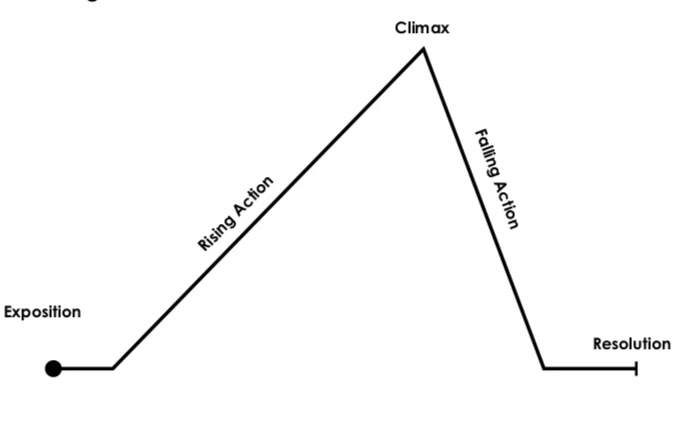
Visual storytelling isn’t just about making things look nice. It’s also about guiding emotion and meaning across time. Lupton describes how the narrative arc – beginning, middle, climax, and resolution – applies to design futures. By using scenario planning to explore futures and design fiction to visualize them, designers can become the storytellers of change. Our ideas, interfaces, and products become solutions as well as the stories that help to shape society.
Designing the Futures We Want
Design fiction reminds us that every image, poster, and product carried a story about who we are and what we might become. By blending visual storytelling with different tools, like scenario planning, designers can use their imagination while also commenting about society as a whole. These speculative visuals allow us to ask, “What kind of future are we designing towards?” When used intentionally, design fiction transforms visual design from being entirely aesthetic to being a method of prediction that can help us see the future and design it responsibly.


 Pixel + Parchment
Leave a comment